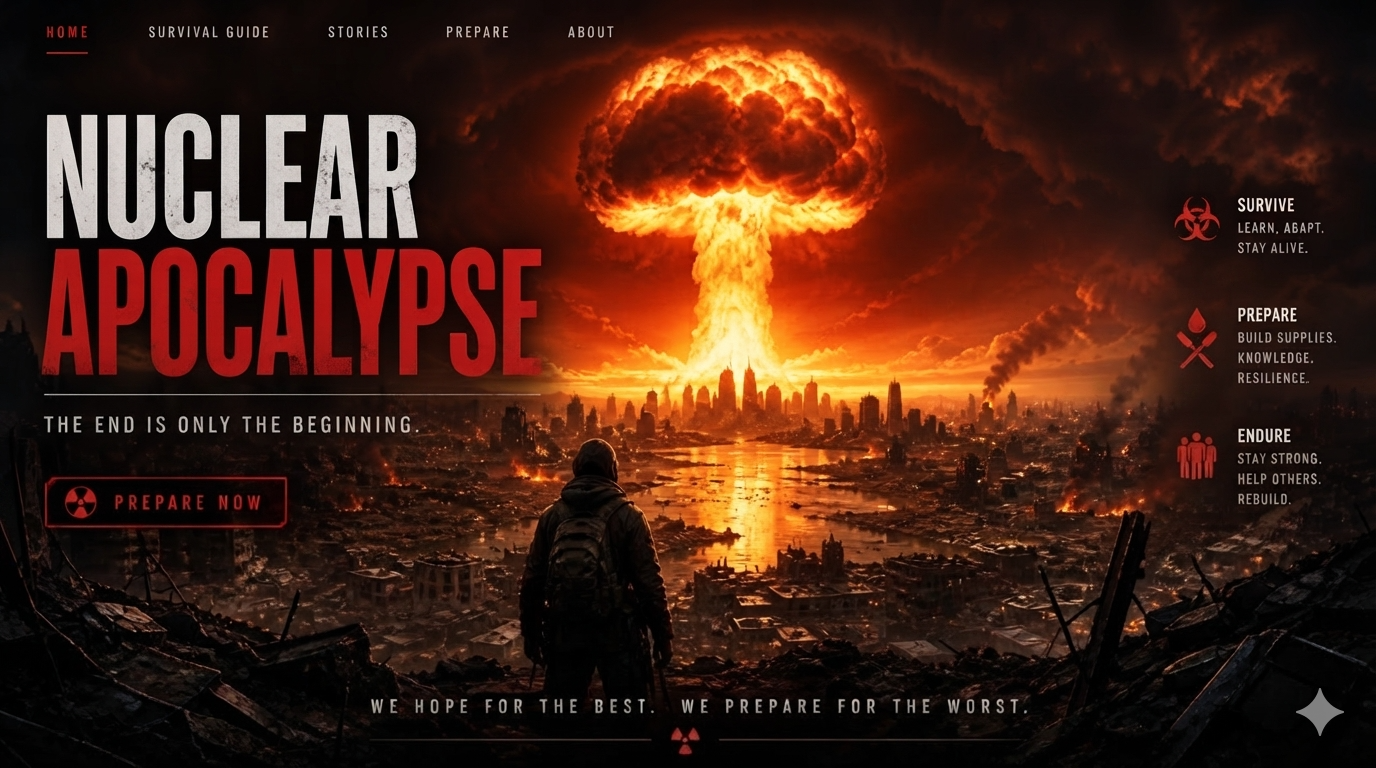
Nuclear Apocalypse Survival Quiz
The nuclear apocalypse has begun. Face 50 difficult decisions involving shelter, fallout, water, food, resources, other survivors and morality. Your choices determine how well you survive — and what kind of person you become.
Make your choices carefully. Survival and morality are measured separately.
This is a fictional nuclear-disaster survival experience. Your result is based entirely on the choices you make during the quiz.
About the Nuclear Apocalypse Survival Quiz
The Nuclear Apocalypse Survival Quiz is a 50-decision fictional survival challenge set after a catastrophic nuclear event. As the situation develops, you must make difficult choices involving shelter, fallout, water, food, medical needs, information, resources and other survivors.
The quiz is designed around more than simply surviving the initial disaster. Early decisions may involve finding protection and reducing unnecessary exposure, while later situations focus on managing limited resources, dealing with uncertainty and working with other people.
Your choices determine a Survival Score, while certain decisions also contribute to a separate Morality Score. This allows the quiz to explore the difference between making the most practical survival decision and making the most compassionate or ethical choice.
The scenario and scoring system are fictional. The quiz is intended for entertainment and general educational discussion, not as a substitute for official emergency instructions, professional medical advice or public safety guidance.
What This Quiz Covers
The 50 decisions cover different problems that could arise during a fictional nuclear disaster. Some situations involve immediate threats, while others focus on managing limited resources and making decisions that could affect you and other survivors over time.
Shelter and Fallout
Some situations involve finding appropriate shelter, reducing exposure and deciding how to respond when radioactive fallout may be present.
Water and Food
The quiz includes decisions involving stored water, food supplies, contamination concerns and managing essential resources when normal services are disrupted.
Medical Problems
Some scenarios involve injuries, illness, medical supplies and difficult decisions about health when normal medical services may be unavailable.
Information and Communication
Other situations involve emergency information, communication problems, uncertainty and deciding which information should be trusted.
Other Survivors
Some decisions involve cooperation, trust, responsibility, conflict and helping other people while trying to protect your own survival.
Morality and Difficult Choices
Certain decisions include a separate morality component. These choices can involve compassion, fairness, responsibility, trust and the willingness to help others when doing so may create additional risks.
HOW THE QUIZ WORKS
The complete quiz contains 50 fictional survival decisions. Every decision presents four possible choices. Read the situation carefully and select the option you believe gives you the best outcome within the scenario.
Each decision can contribute to your Survival Score. Some decisions also contain a separate morality component. The two scores are calculated separately so that survival-oriented choices and moral choices can be represented independently.
A choice that improves survival does not necessarily represent the most compassionate decision. Likewise, a compassionate decision is not necessarily the safest option in every fictional situation.
Your final result also includes an estimated survival time. This is a fictional result generated by the quiz and should not be interpreted as a scientific prediction of how long someone would survive during an actual nuclear disaster.
Quiz Navigation
Starting the Quiz
Select START QUIZ on the opening screen to begin. The first nuclear survival decision will appear with four possible choices.
Choosing an Answer
Read the complete situation and all four choices before deciding. Consider both the immediate danger and the possible consequences of your choice.
Moving Between Decisions
Use NEXT to continue through the quiz. The BACK button allows you to return to an earlier decision and reconsider your previous choice before submitting the quiz.
Completing the Quiz
Continue until all 50 decisions have been completed. When you are finished, select SUBMIT to calculate your Survival Score, Morality Score, estimated survival result and final description.
Trying Again
After seeing your result, select TRY AGAIN to replay the quiz and experiment with different decisions. You can also use SHARE MY RESULT or CHALLENGE SOMEONE to compare your results with other players.
FREQUENTLY ASKED QUESTIONS
How many decisions are in the quiz?
There are 50 fictional survival decisions, and every decision provides four possible choices.
What does the Survival Score measure?
The Survival Score represents how effectively your decisions address the fictional survival challenges presented throughout the quiz. A higher score indicates stronger overall survival decision-making within the scenario.
What is the Morality Score?
The Morality Score is a separate measurement based on decisions that contain a morality component. It reflects patterns in your choices involving factors such as compassion, fairness, trust and responsibility.
Can I have a high Survival Score and a lower Morality Score?
Yes. The two scores measure different aspects of your decisions. A choice that improves your chances of survival does not necessarily represent the most compassionate or fair decision.
What is nuclear fallout?
Nuclear fallout refers to radioactive material that can settle on surfaces and areas after certain nuclear explosions. Fallout can create an exposure hazard after the initial event, and radioactive contamination cannot reliably be identified simply by looking at an area.
Why is shelter important?
During a nuclear emergency, appropriate shelter can provide protection from several hazards. In particular, putting substantial material between yourself and radioactive fallout can reduce exposure. Real emergency decisions should always follow official instructions.
Can radiation be seen or smelled?
Radiation itself cannot reliably be detected using ordinary human senses. An area may look normal while still presenting a contamination hazard, which is why reliable emergency information and appropriate monitoring are important.
Why are water and food important?
A major disaster can disrupt electricity, water treatment, transportation and food distribution. Stored supplies can therefore become important. Whether a particular food or water source is safe depends on the contamination and emergency conditions.
Why does reliable information matter?
Emergency information can help people understand sheltering, evacuation, contamination and available assistance. Disasters can also create rumors and misinformation, so decisions based on reliable sources are preferable to guesses or assumptions.
Does the quiz provide real emergency instructions?
No. The quiz uses real concepts as inspiration, but its scenarios and scoring are fictional. During an actual nuclear emergency, follow instructions from official emergency-management, civil-defence and public-health authorities.
Can I change my answers?
Yes. You can use the BACK button to return to earlier decisions and reconsider your choices before submitting the quiz.
Can I take the quiz again?
Yes. Select TRY AGAIN after receiving your result to restart the quiz and experiment with different decisions.
Can I challenge my friends?
Yes. After completing the quiz, use CHALLENGE SOMEONE to share the challenge and compare your survival results with other players.